The Prevention and Health Promotion Team is committed to diverse, interdisciplinary teaching and research in key areas of prevention and health promotion.
Through our Bachelor’s and Master’s degree programmes, we equip students for careers in both professional practice and academia – through evidence-based and practice-oriented teaching.
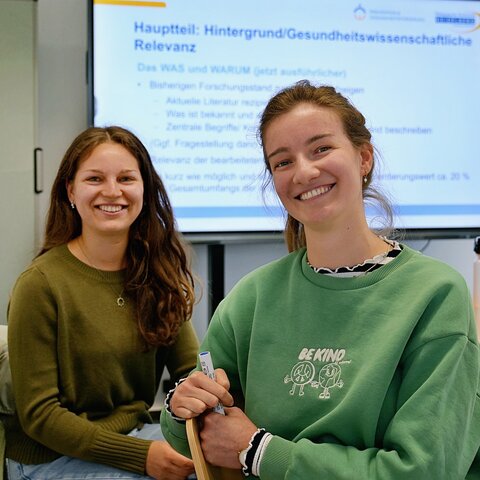

This is where I work today:
Employer: AOK health insurance company - prevention division
Job: Coordinator for prevention work in schools, day-care centres, local authorities, sports clubs
Brief description: First point of contact, planning and implementation of prevention measures in the areas of exercise, healthy eating and mental health
What I particularly like: Alternating between days spent coordinating at my desk and practical assignments with lectures, workshops, action days in different settings
My memories of my time at university:
Particular challenge: Organising myself during homework
What I particularly benefit from: Content on healthy eating, exercise breaks, moderation, networks, healthy communities, municipal health conferences
My tips:
Do several internships
Don't be put off by job advertisements that don't fit your profile 100% or require "several years of professional experience"
My degree programme in three words:
varied | practice-orientated | broad overview of the topic of health

This is where I work today:
I have been working for the German Climate Change and Health Alliance (KLUG e.V.) since autumn 2023. We are committed to integrating planetary health - i.e. the link between health, climate and the environment - into health policy structures and into various (environmental) environments for prevention and health promotion. My tasks include the development and implementation of target group-specific communication concepts, information materials, workshops and further education formats based on the transformative education approach.
What I particularly appreciate: I can work in a meaningful and value-oriented way, follow my interests and work together with other people to shape conditions in such a way that healthy and climate- and environmentally friendly behaviour can be promoted.
My memories of my student days:
After leaving school, I had a clear professional goal: to help people stay healthy - not just when they are already ill. That's why I chose the Prevention and Health Promotion degree programme. I was already interested in sustainability before I started the programme. I only really realised the connection between climate, environment and health during my studies. The seminar on "Stealth Interventions" in the first semester was an aha moment. In other words, measures that don't seem like health promotion at first glance, but can have a big impact. Today I understand this to mean Measures with co-benefit potential that are healthy for health, climate and the environment.
I was able to pursue my interests in a targeted manner in my term papers and final theses. The theories of health psychology, analysing the determinants of health and intervention mapping were particularly valuable for me. I still enjoy looking through my old documents today, as they contain so many basic principles and potential applications.
My empirical bachelor's thesis was a challenge: conducting interviews, analysing data, filtering and discussing results without losing sight of the research objective. Looking back, I am very grateful that I was able to gain this experience early on.
What my degree programme gave me in particular: Creating transfer, combining professional and social perspectives. This is exactly what the cross-cutting topic of planetary health is predestined for. When I was a student, Planetary Health was not yet explicitly anchored in the module handbook. So I'm all the more pleased that it is being given more and more space today.
My tips:
Remain open to interdisciplinary approaches. Health promotion is multifaceted. This makes perspectives from psychology, sociology, environmental science and many other disciplines all the more valuable. And above all: professional roles can be customised. Many jobs in prevention and health promotion are only created by the people who fill them with life. Have the courage to go your own way and follow your interests.
My degree programme in three words:
Foundation | Transfer | Relational prevention

This is where I work today:
Today I work at Animals Helping Handicapped - Institute for Animal-Assisted Intervention as a specialist in animal-assisted intervention and head of the education department (basic, further and advanced training in the field of TGI).
Alpacas, chickens & co. enrich my work here. In concrete terms, this can involve helping adults with catatonic schizophrenia to get moving again, for example, or working with children with autism to find new ways of dealing with frustration.
What I find particularly valuable in my job is the connection between nature, animals and health in a social, therapeutic and educational context, as well as the ethics that are paramount when working with our animals.
My memories of my student days:
My degree in Prevention and Health Promotion was an absolute gut decision for me - I knew it was the right degree programme for me. The degree programme was an absolute enrichment - the start in the professional world was a bit bumpy. I didn't quite know what to do with my knowledge at the beginning. How do I manage to utilise the valuable knowledge and pass it on to other people? Much of what I learnt during my studies helps me in my everyday life and career to maintain an overview and my health. The elective subjects in particular have played a big part in this.
My tips:
Take one step at a time. Always reflect on yourself and think about what you enjoy and build up a network with people who work in the field you would like to work in one day.
My degree programme in three words:
valuable | courageous | innovative

This is where I work today:
Programme Coordinator teamw()rk for Health and Work at Hessische Arbeitsgemeinschaft für Gesundheitsförderung e.V. My central concern is to actively involve the dialogue group of unemployed people in the process of designing and implementing health promotion activities in order to enable them to take control of their own health. In this context, I greatly appreciate the close cooperation and dialogue with other stakeholders in the participating Hessian districts. We are working together to develop and establish health-promoting structures. These intensive collaborations and the promotion of interprofessional cooperation are the key to realising our goals.
My memories of my student days:
I look back with gratitude on my time as a student, during which I was not only able to learn a lot professionally, but also gained a comprehensive insight into the various subject areas of prevention and health promotion. It was a challenge to orientate myself and find a clear direction in view of the wide range of professional opportunities. In this context, my work - initially as a student assistant and later in the EUBeKo research project - was particularly helpful and enabled me to transfer theoretical knowledge into practical application at an early stage. My special thanks go to Jens Bucksch, Lisa Paulsen, Chiara Dold and Lea Benz for their trusting collaboration and the numerous opportunities for professional and personal development.
My tips:
Take advantage of practical opportunities early on to combine theory with application - whether as a student assistant, in projects or internships. Build up a network and remain open to different professional fields. Regularly reflect on your interests and career goals. Show initiative, get involved beyond your studies and develop your soft skills. Setbacks are part of it - the important thing is to stick with it and learn from them.
My degree programme in three words:
formative | inspiring | supportive

This is where I work today:
Since completing my bachelor's degree, I have been working in the Heidelberg self-help office in the area of self-help support - a field of work that I was able to familiarise myself with intensively during my internship semester.
My tasks include counselling people who are interested in self-help, accompanying and supporting existing self-help groups, cooperation and networking, coordinating projects and public relations work. What I particularly appreciate about this job is the work with different target groups and the varied tasks. I am always impressed by the great commitment of the people who are actively involved in self-help.
My memories of my time as a student:
What I particularly liked about the Prevention and Health Promotion degree programme was the wide range of topics and specialisms - physical activity promotion, nutrition, project management and networking as well as community health promotion. I can use a lot of the content, especially project management and networking, in my everyday work today. Central basic concepts of health promotion such as empowerment and participation also accompany me in my work every day. If I could start the programme again, I would take advantage of more networking opportunities from the outset and do more internships - simply to gain even more practical experience and get to know different perspectives.
My tips:
Take advantage of internships and other practical opportunities to gain experience early on and make your first professional contacts. Remain open to different fields of work - even those that may not be directly related to health promotion at first glance. If you are planning a Master's programme, stay curious and open to different fields of study.
My degree programme in three words:
versatile | interactive | good basis

This is where I work today:
I have been working as a health promotion officer at the Hessische Arbeitsgemeinschaft für Gesundheitsförderung e.V. (HAGE) in Frankfurt for five years. I started out in a project to promote physical activity for older people in the community. Together with municipal partners, the aim was to establish and expand low-threshold exercise programmes and exercise-friendly structures in urban areas. The aim was to network key players and thereby create synergies. My activities now focus on the following areas: Coordinating a nationwide prevention programme to promote mental health and destigmatise mental illness, designing and organising specialist events and interdisciplinary committees and scientifically evaluating various projects. What I particularly like about my work is the variety of content. No two days are the same - classic routine tasks are the exception. I also appreciate the professional exchange with universities, including the Department of Prevention and Health Promotion at the PH: due to thematic overlaps, there have already been several collaborations in the form of workshops or specialist impulses.
My memories of my time as a student:
I particularly remember practical assignments and involvement in events that directly linked theory and practice. With a few exceptions - such as the health policy module - the course was characterised by lively, practice-oriented content. Today, I particularly benefit from the interdisciplinary view of the topic of health. This "wide-angle view" makes it easier for me to work with stakeholders from different areas of politics and life. Health in All Policies (HiAP) is not an abstract concept, but something I encounter in my daily work in a very concrete way. The degree programme also gave me a wide range of insights into different subject areas. I was able to set my own specialisations and deepen these in a further Master's degree course. Looking back, I can say that the degree programme gave me a wide-ranging toolbox - and I was able to put together the right tools myself.
My tips:
Make active use of your time at university to network - even outside the PH environment. Keep in touch - internships or working student jobs can not only be eye-openers, but also door-openers.
My degree programme in three words:
diverse | networking | approachable

This is where I work today:
Research Assistant / Post Doc University Hospital Heidelberg, Department of General Medicine and Health Services Research. After completing my Bachelor's degree in Health Promotion, I studied the Master's programme "Health Services Research and Implementation Science in Health Care M.Sc." at Heidelberg University from 2015 to 2017. After an internship in a research project and my Master's degree, I applied for a position in a research project at the department where I still work today.
I have been working as a health services researcher and implementation scientist in various health services research projects since 2018. I am involved in conducting process evaluations, study management and developing interventions for primary care. I enjoy my work in teaching on a Master's degree programme on qualitative research and in the Human Medicine degree programme on health promotion. I enjoy writing and am therefore pleased that I can publish my research findings and contribute my expertise to research proposals.
My memories of my time at university:
My knowledge from my Bachelor's degree is and was a really good basis for my work. In particular, the methodological skills I learnt were always very helpful. Most of the lecturers I got to know at the PH are probably no longer active in the degree programme, but the story of a former postman definitely made a big impression on me. It's great that movement is still a strong topic! And my family still laughs today at my explanations of Schulz von Thun's "4 ears model"!
My tips:
Internships are good opportunities to familiarise yourself with different fields. I also believe that a Master's degree programme is a good way to successfully enter interesting jobs.
My degree programme in three words:
understandable | manageable | meaningful
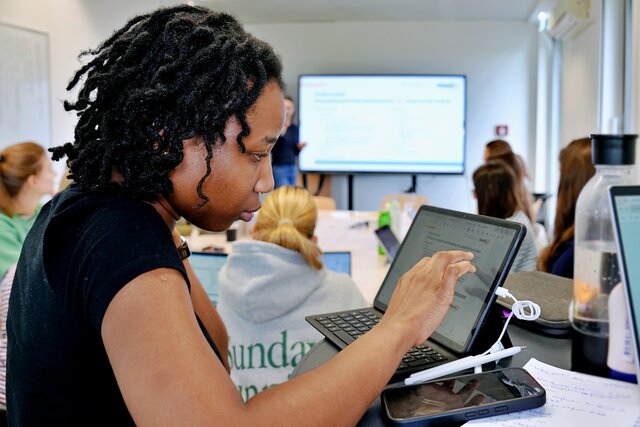
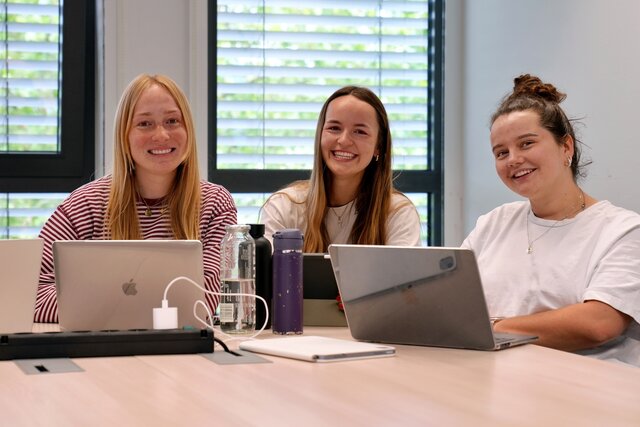
Sophie and Timo explain why they chose to study Prevention and Health Promotion at Heidelberg University of Education and give you an insight into everyday student life. Their favourite thing about the course: health can be viewed from so many different perspectives, and the course thrives on dynamism and close interaction with their fellow students and lecturers.
Once you’ve graduated, there are also plenty of different opportunities open to you!
You can apply for a place on the course for the winter semester 2026/2027 until 15 September 2026 – including for the Master’s in Community-Based Health Promotion.