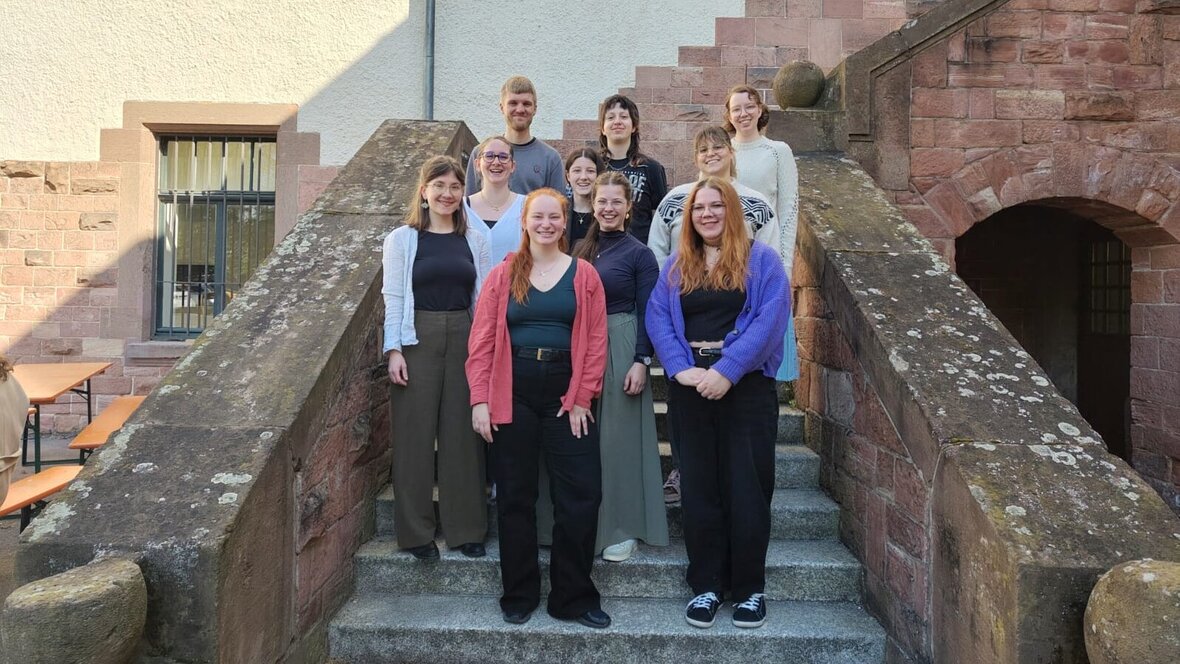
We, the sign language interpreting student council, are students from all semesters.
Our task is to represent the interests of the students on our degree programme.
We also organise events such as DGS get-togethers and games evenings every semester and implement our own projects.
We also support events organised by our degree programme and our university on occasion.
If you have any questions about the degree programme, about studying at the PH Heidelberg in general or about our student council, just get in touch with us.
Sign language greetings
Your student council

For the B.A. Sign Language Interpreting (GSD) degree programme, there are no other requirements that must be met apart from the general admission requirement of having a higher education entrance qualification (e.g. general higher education entrance qualification (Abitur), Delta exam, etc.). Previous knowledge of German Sign Language (DGS) is not a must, but it is an advantage.
Further advantages in the application process can be gained by providing proof of pedagogically relevant work (see below for examples).
The higher the score, the higher up you are in the ranking list and the more likely you are to be accepted.
Here is an overview of the selection process:
Points are collected in two areas:
1.) A-level grade (max. 30 points)
Grade 1.0 = 30 points; Grade 1.1 = 29 points; Grade 1.2 = 28 points (...) Grade 4.0 = 0 points
2.) Practical pedagogical activities (max. 30 points)
- Pedagogically relevant activities are assessed
- It is possible to score in 5 blocks (max. 30 points achievable in total)
1) Pedagogically relevant or relevant vocational training - min. 2 years (30 points)
2) Pedagogically relevant full-time employment (min. 30 hours/week) (max. 20 points)
E.g.: FSJ, BFD, JFD, activities/internships with professional reference, individual care and support of people with disabilities, assistance activities in social institutions.
Awarding of points - In total:
at least 12 months (20 points)
at least 9 months (15 points)
at least 6 months (10 points)
at least 2 months (6 points)
Example: Au pair stay
Points awarded - In total:
at least 12 months (8 points)
at least 9 months (5 points)
at least 6 months (3 points)
3) Family activities (max. 10 points)
- Raising an own child / foster child (at least 1 year) (10 points)
- Caring for a relative in need of care (at least 1 year) (10 points)
4) Pedagogically relevant part-time activities, also on an hourly basis (max. 5 points)
Ex:
- Church youth work (leading children's and youth groups, children's worship service)
- Music/art (group leader in music clubs, school mentor for music/art)
- Sport (trainer in sports clubs, school mentor for sport)
- Social area (supervisor at camps, youth centre, etc.)
- Tutoring (homework or childcare in recognised institutions)
Points awarded - In total:
over 3 years (5 points)
over 2 years (3 points)
over 1 year or sporadically (1 point)
5) Only for sign language interpreting:
Competences in sign language, language level A 1 (15 points)
(You can also find this information officially on the PH website
You can apply online via the PH
All you have to do is create an account/register.
You will need the following documents during the application process
- University entrance qualification (e.g. final certificate of your general higher education entrance qualification)
- Proof of participation in the orientation test
- If applicable, proof of pedagogically relevant practical activities (e.g. internships, jobs, FSJ)
Pay attention to the application deadline: 15 July!
TIP: It is best to start looking for accommodation/rooms now at the latest.
Halls of residence: You can apply for halls of residence even without a letter of admission or certificate of enrolment!
You can find an overview of the halls of residence of the Heidelberg Student Union
Information on how to apply and the online application form can be
Private rooms: You can find accommodation outside of the regular accommodation agencies
Information on enrolment can be found on your letter of admission, but here it is again in brief:
This is what you need for the enrolment application:
1) Health insurance confirmation from the health insurance company (usually sent electronically directly to the PH)
2) A (digital) photo of yourself for your CampusCard (student ID card)
This is how enrolment works:
1) Print out the enrolment application in the PH
2) Transfer the semester fees
3) Download and save your certificate of enrolment
!Pay attention to the enrolment deadline!
Successfully enrolled?
Then apply for BAföG if necessary. Information, the application and the appropriate forms with instructions can be found on the website of the
You can find the general programme or information on the programme of the advisory days (BeTa) for all degree programmes approx. 1 month before the start of the semester on the
You can find the date for our "B.A. Sign Language Interpreting" first day there or on our Instagram page.
You can find out exactly what we have planned for you on our project page "Erstie-Woche". But the details are of course a surprise! And who knows, since the new 2nd semesters traditionally take over the organisation every year, maybe the programme has changed since last time?