Do you want to enable young people with special educational needs to participate in education? that's possible with the Master's degree in Special Needs Education! As a special education teacher, you will organise lessons according to the individual support needs of your pupils: You specialise in two special education subjects and choose a subject that you study with a view to its didactics and subject-specific sciences. In addition, you will study basic maths or German as well as seminars in educational science, psychology and sociology, among others. You will gain valuable practical experience in several internships.
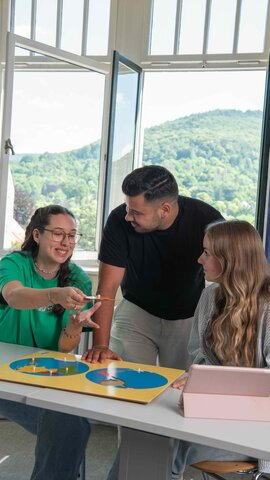
The prerequisite is a completed Bachelor's degree with study components in a special education subject, a teaching subject, educational science and practical school studies.
Do you have a Bachelor's degree in another teaching specialism? Admission is possible - on the condition that you justify your motivation for the special education teaching programme. Please include a letter of motivation for your choice of degree programme and special education subjects in your application.
Missing study components must be made up.
If you have not yet completed your Bachelor's degree at the time of application, you can still apply for admission to the Master's degree programme in Special Needs Education if you can provide proof of at least 142 ECTS from a Bachelor's degree programme related to teaching.
The Master of Education Teacher Training in Special Needs Education programme prepares you specifically for the education and upbringing of children, adolescents and young adults with special educational, counselling and support needs.
As a graduate of the M.Ed. in Special Education, you will be able to design customised educational programmes that are geared towards the individual learning requirements and development opportunities of your students. You will have in-depth subject-specific knowledge and will be able to combine this with concepts of research-based specialised didactics and educational science in a theory-based manner.
You will develop a scientifically sound, research-based and practice-orientated habitus that will enable you to professionally reflect on and shape challenges in the context of inclusion and diversity. You will also have the willingness to continuously learn independently and critically reflect on your own educational process. The degree programme thus lays the foundation for lifelong learning and continuous professional development in your professional field.
The programme is divided into 6 study areas:
- Educational sciences with a focus on educational science
- one subject including subject science, subject didactics and methodology
- Special educational fields of action with compulsory and elective fields of action
- First special education specialisation (subject-specific specialisation in psychology, diagnostics, pedagogy and didactics)
- Second special education specialisation (subject-specific specialisation in psychology, diagnostics, pedagogy and didactics)
- Practical school studies with a total of 2 internships (block internship and professionalisation internship, 4 weeks each)
Standard period of study: 4 semesters
The degree programme comprises 120 credit points. One credit point corresponds to around 30 hours of student work (attendance, preparation and follow-up work, self-study, examination).
So that you can apply the theoretical principles from your degree programme directly in practice, you will complete two internships during your studies.
You will complete the four-week block placement (BP) at a school specialising in your second special education subject.
You will complete the four-week professionalisation internship (PP) at a school or at an institution cooperating with a school in Germany or abroad.
Our Centre for Practical School Studies (ZfS) is your first point of contact for questions relating to the practical school components of your studies.
To the Centre for Practical School Studies
The degree programme offers you the opportunity to integrate a stay abroad into your studies - either via an exchange programme or self-organised. If you would like to venture beyond Germany, you can study abroad for a semester at a university or complete an internship, for example.
The International Office can provide you with information and advice on the various options and scholarship programmes.
To the International Office
You will graduate with the academic degree "Master of Education" (M. Ed.), which qualifies you for a career in a pedagogical field such as educational and family counselling, all-day school supervision or in educational centres. An academic career or doctorate is also possible after the Master of Education.
important: After completing this degree programme, you are not yet a teacher!
However, you will qualify to start the 18-month preparatory service for the special education teaching profession. After successfully completing this programme, you will be able to teach as a teacher at special education institutions or at mainstream schools in the context of inclusive education.
How about democracy education, information and media skills or intercultural learning support? These are just three examples of the attractive additional qualifications that you can acquire as a prospective teacher at the Heidelberg University of Education. You usually complete these additional qualifications with a certificate.
To the overview of additional qualifications


