A warm welcome to all our new students!
The Institute of Geography and Geocommunication at the University of Education wishes you a great start to your studies.
To give you an initial overview of the subject of Geography, we have put together a brief summary of the course content for you. You will explore various areas of Geography and, in doing so, learn to understand spatial processes, analyse social and ecological interrelationships, and communicate knowledge in a practical way.
If you have any questions, please feel free to contact Mr Raimund Ditter at any time.
We’re delighted to have you here!
Student Advisory Service
The study guides provide a clear overview of the degree programme. They show which modules are scheduled for which semester, how many credit points are awarded and which examinations are due. They also make it clear which placements and practical sessions are included and how much time should be set aside for coursework and self-study. In this way, the study guides serve as a guiding thread and help students to organise their studies effectively.
Name: Advanced Course in Human Geography and Research Methods II
(Human Geography) with particular emphasis on
heterogeneous learning groups
Module scope: 9 LP ( of which subject didactics: 3 LP); 2 seminars (2 SWS each, 3 LP)
1 seminar (2 SWS, 2 LP)
Module coordinator
Examination format: written assignment, 1 LP (graded)
Name: Advanced Course in Human Geography and Research Methods II, with
with a particular focus on heterogeneous learning groups
(including placement supervision)
Module scope: 12 LP, 2 seminars (2 SWS each, 3 LP)
1 seminar (2 SWS, 2 LP)
[1 ISP support seminar (2 SWS, 3 LP)]
Module coordinator
Examination format: written assignment, 1 LP (marked)
Name: Advanced Studies in Physical Geography and Human Geography in
Research and Practice
Module scope: 12 LP ( of which subject didactics: 5 LP); 2 seminars (2 SWS each, 3 LP)
1 project (2 SWS, 4 LP)
1 colloquium (1 SWS, 1 LP)
Module coordinator
Examination format: Written examination (120 mins), 1 LP (marked)
Title: Regional Geography in a Non-European Major Region (including
extensive fieldwork, held every 14 days) and an in-depth study of
Geography Didactics
Module scope: 12 LP ( of which subject didactics: 3 LP); 2 seminars (2 SWS each, 3 LP)
1 major field exercise (3 SWS, 5 LP)
Module coordinator
Examination format: Presentation with a written
report, 1 LP (graded)
The sub-discipline of regional geography focuses on specific areas of the Earth’s surface and analyses them in terms of their characteristic structures and processes, human influence and the resulting interactions. These include:
- Local, regional, national, international and global spatial analyses
- Human–environment relationships
-
1x1-des-Exkursionspasses.pdf (157 KB, PDF) -
Exkursionspass_NeuesLayout.pdf (1 MB, PDF) -
Lehramtstudium_Geographie_FlyerBF.pdf (2 MB, PDF) -
Leitfaden_für_die_Anmeldung_zu_ExkursionenBF.pdf (458 KB, PDF) -
Mastercolloquium_Sammlung-Neu.pdf (150 KB, PDF) -
Abschlussarbeiten_Geographie.pdf (2 MB, PDF) -
Wissenschaftliches_Arbeiten.pdf (4 MB, PDF)
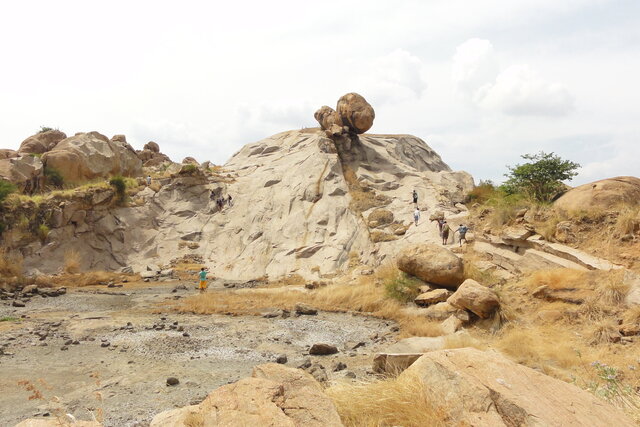
“Fieldwork is at the heart of geographical work” – this view, shared by many geographers, is also one of the guiding principles of the degree programme. Through a series of field trips, ranging from the local area to distant locations, the fundamentals of spatial learning will be explored using field trip-based teaching methods. Always with a focus on participatory engagement, a wide variety of locations around the world will be visited and analysed in terms of their physical and human geographical characteristics. In addition to the use of digital geomedia, the emphasis is always on testing and applying geographical field methods.
About our field trips