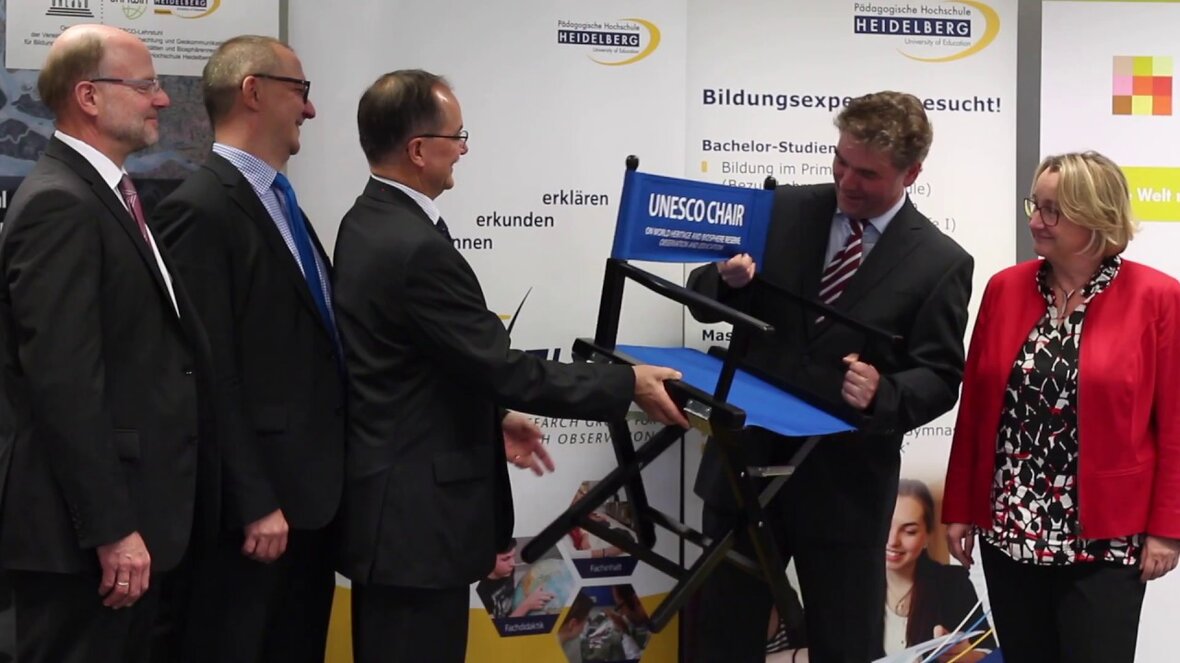
The UNESCO Chair in Earth Observation and Geocommunication of World Heritage Sites and Biosphere Reserves was established by a resolution of UNESCO in Paris on 6 September 2016 at the Heidelberg University of Education, within the Institute of Geography and Geocommunication – Research Group for Earth Observation (rgeo). The Chair is one of 17 UNESCO Chairs in Germany and the only one in the federal state of Baden-Württemberg. The Chair is held by Prof. Dr Alexander Siegmund.
The UNESCO Chair in Earth Observation and Geocommunication of World Heritage Sites and Biosphere Reserves promotes modern methods of environmental and sustainability research, as well as Education for Sustainable Development (ESD). The focus is on digital geoinformation technologies such as satellite remote sensing and geographic information systems, as well as innovative laboratory and field methods for monitoring, assessing and visualising environmental changes.
The emphasis is on UNESCO World Heritage Sites, biosphere reserves, geoparks and other landscapes particularly threatened by climate change, such as coastal regions and forests. New approaches to environmental research and communication are intended to contribute to the protection, analysis and communication of these sites. The research findings support quality management, conservation and awareness-raising regarding these universal sites, and combine modern environmental research with sustainability education – entirely in line with the guiding principle: ‘Recognise, Explore, Explain – Understanding the Earth System and Shaping it Sustainably.’

All tentative and nominated UNESCO World Heritage Sites and biosphere reserves require greater scientific support in order to meet the complex challenges of our time. Modern geoscientific technologies such as digital geomedia, remote sensing and geo-ecological laboratory and field methods enable comprehensive environmental monitoring, analyses of land-use changes and the development of sustainable management strategies. This range of methodologies offers managers of UNESCO sites practical support with inventorying, risk analysis, intervention planning and continuous monitoring.
The Institute of Geography and Geocommunication – Research Group for Earth Observation (rgeo), which holds the UNESCO Chair, uniquely combines these approaches and possesses particular expertise in geo- and environmental sciences as well as education for sustainable development. In doing so, it promotes communication and exchange regarding humanity’s cultural and natural heritage, particularly with young people, thereby contributing to the protection of and raising awareness about endangered UNESCO sites.

The UNESCO Chair in Heidelberg is based at the Institute of Geography and Geocommunication – Research Group for Earth Observation (rgeo) at Heidelberg University of Education and is headed by Prof. Dr Siegmund.
The UNESCO Chair focuses on three key research areas: digital geomedia, adaptation to climate change, and education for sustainable development. The first two research topics are prominently represented in the Chair’s two centres of excellence, the ‘GIS Station – Centre of Excellence for Digital Geomedia’ and the ‘Geco-Lab – Centre of Excellence for Geo-ecological Spatial Exploration’, whilst the latter topic is covered by the ‘Heidelberg Centre for Education for Sustainable Development’, which opened in July 2018. The centre was co-founded by the UNESCO Chair and is headed by its Chairholder, Prof. Siegmund, as its founding director.
The Department of Geography, within which the UNESCO Chair is based, aligns its research and teaching closely with the Sustainable Development Goals (SDGs) and focuses in particular on the following SDGs: 4, 11, 12, 13, 15, 17
Projects of the UNESCO Chair: An overview of current projects of the Heidelberg UNESCO Chair can be found at:

The UNESCO Chair at Heidelberg University of Education has an extensive network of regional, national and international partners. This network has been established through a wide range of research and development projects, exchange programmes for students and teaching staff, field trips, and close collaboration with UNESCO partner institutions.
The global research network enables students, staff and affiliates of the Institute of Geography & Geocommunication to draw on international contacts in order to develop, exchange and jointly interpret knowledge on a global scale. The UNESCO Chair’s international collaborations make it a global think tank that actively promotes the exchange and further development of knowledge in the fields of geography and geocommunication.

The UNITWIN/UNESCO Chairs Programme was launched in 1992 to embed UNESCO’s objectives in education and science worldwide. It promotes international cooperation and networking between universities, strengthens academic capacity through the exchange of knowledge and close collaboration, and is one of UNESCO’s most prestigious academic initiatives. Currently, around 900 UNESCO Chairs in over 120 countries are collaborating within the framework of the programme. They conduct research and teach in UNESCO’s key areas of work and act as multipliers in the implementation of its objectives. Inter-university cooperation, international networking and intercultural dialogue are at the heart of the programme.
The programme aims to expand cooperation networks and partnerships between universities in order to promote the mobility and exchange of researchers, lecturers and students, thereby facilitating the global transfer of knowledge. The UNESCO Chairs see themselves as think tanks and bridge-builders between academia, civil society, local communities, and the worlds of research and politics. Through the UNITWIN network, the UNESCO Chair in Heidelberg has strengthened its partnerships with global stakeholders – particularly in the Global South – and works closely with UNESCO headquarters in Paris as well as other field offices worldwide.
