A survey by the PHHD shows that students’ day-to-day university life is spent almost entirely sitting down – universities can counter this by providing spaces and teaching formats that encourage physical activity
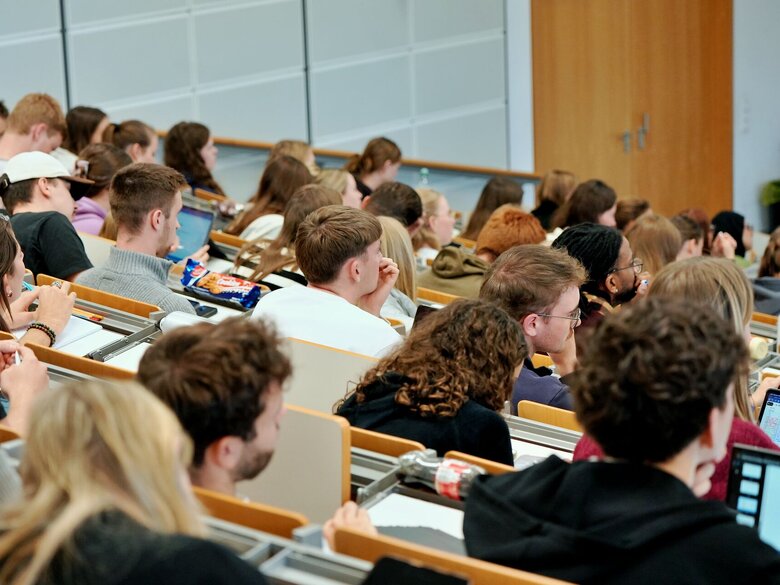
Students spend a large part of their day sitting down – on average around twelve hours. This is shown by a study carried out by
The researcher surveyed more than 400 students at the Heidelberg University of Education (average age 23) online. Among other things, participants were asked to state how much time they spend sitting during a typical day at university, how long they sit during a typical 90-minute lecture, and how often they take a break from sitting during that time.
Only study-related periods, such as lectures or individual study sessions, were taken into account; leisure activities were excluded. Even so, the students spent an average of 12.4 hours a day sitting. In lectures, they sat for an average of 85 out of 90 minutes.
55 per cent of those surveyed even stated that they did not stand up even once during a lecture. However, those who felt confident about changing their own sitting behaviour – experts refer to this as ‘motivational self-efficacy’ – sat for less time overall and stood up more frequently during lectures. A similar pattern was observed among students who felt they were free to decide for themselves when to stand up.
Universities must create scope for movement
“But sitting is not just an individual decision,” explains Möckel. Social norms and expectations, the design of spaces and institutional structures also play a major role. For instance, lectures traditionally take place predominantly whilst seated and leave little scope for breaks or physical activity. This is also reflected in seminar rooms, which are predominantly equipped for sedentary activities. By contrast, students who perceived their learning environment as conducive to movement stood up significantly more often.
It is well known that too much sitting leads to health problems – the World Health Organisation recommends breaking up long periods of sitting every 30 to 60 minutes. Although young adults are generally less associated with health problems, a study by the European Commission suggests that students are considered a high-risk group in this regard: the proportion of those who sit for more than eight and a half hours a day is just as high among students as it is among managers.
Möckel believes that targeted interventions are particularly important during this crucial phase of life. The study helps to better understand on what occasions and why so much time is spent sitting whilst studying. “Universities should consider reforms that reduce the pressures to sit and increase freedom of movement,” says the researcher, “for example, through physically active teaching formats and by redesigning learning spaces.”
Publication:
Text: Antje Karbe
Photo: Birgitta Hohenester
A topic in research and teaching
With the ‘Heidelberg Model of Active Teaching’, researchers at the PHHD have developed an innovative teaching and learning concept that integrates movement as a pedagogical principle into teaching and is now being used to redesign the first of the PHHD’s teaching spaces.
Since April 2026, the Department of Prevention and Health Promotion has also been conducting research as part of the ‘Education in Motion!’ project, funded by the Dietmar Hopp Foundation, which aims to embed active teaching in primary and secondary schools. As part of this initiative, trainee teachers, probationary teachers and qualified teachers are being trained to deliver lessons that promote physical activity. For more information, visit