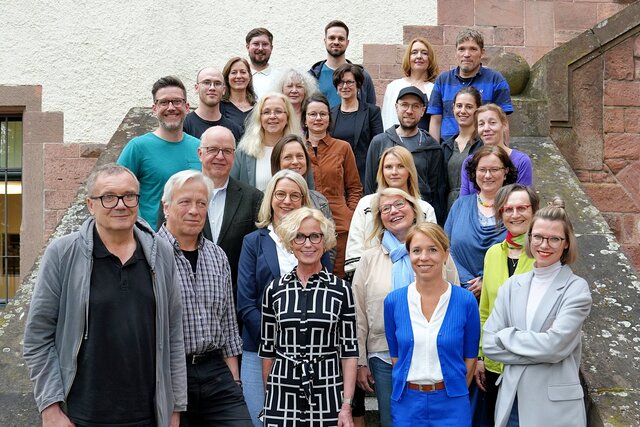
The Institute sees research as a reflexive, critical and constructive contribution to the further development of educational theory and practice in a complex, changing society. Research at the Institute of Educational Science at Heidelberg University of Education is characterised by a broad theoretical foundation, methodological diversity and high social relevance. It is closely linked to the central challenges of contemporary societies and focuses on issues such as justice, participation, democracy, education for sustainable development and the professionalisation of educators and transformation processes in education systems.
Many of the Institute's research projects are interdisciplinary in nature - they are often characterised by a close connection between theory and practice and are then developed in cooperation with educational institutions, ministries, local authorities or international partner institutions. They are realised as third-party funded projects or as self-financed projects. Doctoral projects and the promotion of young academics are an integral part of the Institute's work.
The Institute's research activities are diverse and complement each other:
Education and social inequality: analyses of the conditions, effects and forms of processing social inequality in the education system are the focus of numerous empirical studies.
Inclusion, diversity and heterogeneity: The Institute researches the design of inclusive educational processes with particular consideration of diversity in terms of migration, culture, language and socio-economics.
Professionalisation of educational professionals: Several projects investigate the conditions, dynamics and models of professional educational action - particularly in the context of teacher training, early childhood education and school educational practice.
Digitalisation and education: The impact of digital media on learning and educational processes, on institutional structures and on the role of educational professionals is a growing field of research at the institute.
Philosophy of education and upbringing: By visualising the historical, cultural and social conditionality of education and upbringing, current negotiations and negotiations in the context of global transformation processes are reflected upon theoretically.
Historical educational research: By analysing historical developments in the education system, current discourses are contextualised and critically reflected upon in educational science.
- Higher education research and academic practice: Research on the institution of higher education is aimed at analysing the course of studies, teaching-learning processes and questions of academic education and governance.
School teaching consists of multitasking. Taking children with different talents and cultural backgrounds on board, offering new forms of learning, conveying democratic values and also promoting digital school and teaching development - teachers are constantly required to adapt to new developments. How research can contribute to exploring and further developing the professionalisation of teachers for school practice was the topic of the 6th IGSP Congress "Professionalisation through school practice?" at the Heidelberg University of Education in March 2025.